Horizon Corner

Presentation

Horizon Europe is the EU's main funding program for research and innovation, with a budget of 95.5 billion euros.

This framework programme combats climate change, contributes to achieving the UN Sustainable Development Goals, promotes EU competitiveness and growth, facilitates collaboration and strengthens the impact of research and innovation in developing, supporting and implementing EU policies, while responding to global challenges, supports the creation and better dissemination of excellent technologies and knowledge, creates jobs, encourages the full participation of the EU talent pool, stimulates economic growth, promotes industrial competitiveness and optimizes the impact of investment in a strengthened European Research Area.

Science Technology

This program fosters scientific and technological excellence in the EU and strengthens the European Research Area (ERA).

Society

This program addresses policy priorities, including the green and digital transitions and the sustainable development goals.

Economy

This program increases the uptake of innovation, competitiveness and employment in Europe

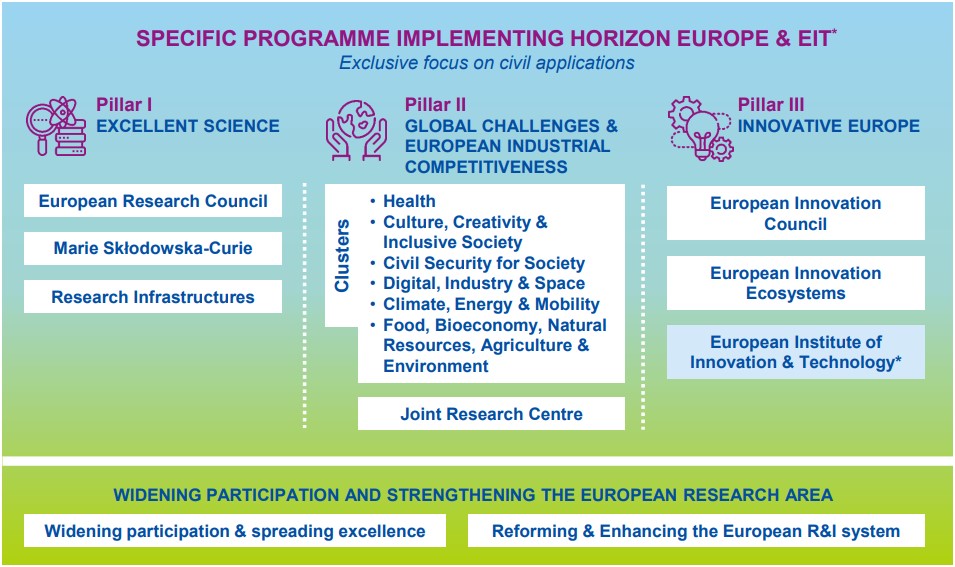
Program structure
Gemini Generated Image vim7ddvim7ddvim7 1

Impact Pathways

The Horizon Europe legislation defines three types of impact accompanied by the main impact pathways.

Scientific Impact

Generate new high-quality knowledge;

Strengthen human capital in R&I;

Promote the dissemination of knowledge and open science.

Social Impact

Address EU policy priorities and global challenges through R&I;

Deliver benefits and impact through R&I missions;

Strengthen the acceptance of R&I in society.

Economic Impact

Generate growth based on innovation;

Create more and better jobs;

Leverage investment in R&I.

Lusófona University projects

I Pilar I – Science of Excellence

Marie Skłodowska-Curie Actions | Postdoctoral Fellowships

FRICTIONS - Centring the Transformative Adminsitrative Practices of Small-scale Cultural Initiatives as Empowering Tools to Engage with the Climate Crisis (2024 – 2026)

EPH-FEM-PI- Exploring Ephemeral Feminisms on Portuguese Instagram (2022 – 2024)

Marie Skłodowska-Curie Actions | Staff Exchanges

RESILIENT - Rural Early Sensing and Intelligent Learning for Integrated Environmental Threat detection (2026-2030)

Beyond Epicenters: Assessing Earthquake Vulnerability Through Economic and Social Networks (2026-2030)

AQUADETECT - Advanced quantum avalanche detectors for aquatic monitoring (2026-2030)

NEURO-CHILD - A Holistic Neuroarchitectural Approach to Child-Centred Healthcare Design: A Multimodal Framework Using Mixed Reality and Artificial Intelligence (2026-2030)

ANTIDOTE – Al Attack and Defense for the Smart Healthcare (2025 – 2028)

E-NOSE - Electron Nose: Acquisition and Modification of Hierarchically Nanostructured Oxide Active Materials for Advanced Biological Gas Sensor Project (2024 – 2028)

DETMED - Novel Detector Concept for Medical Gamma Probe (2023 – 2027)

INNMEDSCAN - Innovative Photodetector Module for advanced Hybrid “Magnetic Resonance Imaging/Positron Emission Tomography” Scanners for Nuclear Medicine (2023 – 2027)

AQUA SYNAPSE: The health benefits of deuterium depletion on synaptic function, regional metabolism, and behaviour (2023 – 2026)

REMARKABLE - Rural Environmental Monitoring via ultra wide-ARea networKs And distriButed federated Learning (2023 - 2026) 

EWALD – Earth Observation for Early Warning of Land Degradation at European Frontier (2022 – 2026)

PhytoAPP - Innovative Water-Soluble Phytomaterial Inhibitors for Alzheimers and Parkinsons Diseases Prevention (2021 – 2025)

SOSClimateWaterFront - Linking Research and Innovation on Waterfront through Technology for Excellence of Resilience to face Climate Change (2019-2023)

NANOGUARD2AR - Nanomaterials-based innovative engineering solution to ensure sustainable safeguard to indoor air (2016-2019)